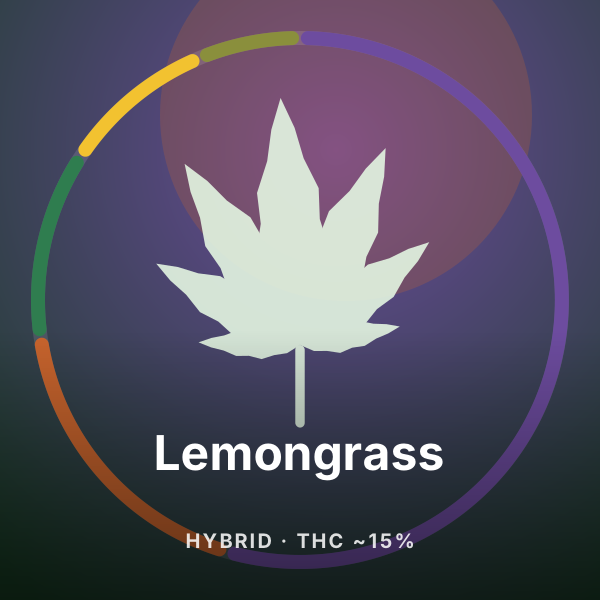
Lemongrass
aka Lemon Grass, Lemon GasHybridTHC range is the middle half of 13 public lab tests of Lemongrass flower (2021–2022). Source: Cannlytics lab results, CC BY 4.0.
About Lemongrass
Lemongrass is a hybrid strain that comes from a cross of Lemon Kush Bx5 with Humboldt Gelato Bx3. You may also see it sold as Lemon Grass, Lemon Gas. People who try it most often describe feeling creative, focused and uplifted.
THC and potency
Across 13 public lab tests of Lemongrass flower between 2021 and 2022, the median result was 15.1% total THC, with half of all samples falling between 14% and 16.5%. That is in line with most flower on Canadian shelves. Potency varies by grower and batch, so always check the label.
Aroma, flavour and terpenes
Its reported terpene profile is led by myrcene, with caryophyllene and pinene. Myrcene is known for earthy, musky notes with a ripe-fruit edge, while caryophyllene adds black pepper and warm spice. On the palate, people pick out lemon, menthol and coffee.
Reported effects
Beyond feeling creative, reviewers also mention feeling energetic and happy. Some consumers say they reach for it when dealing with stress, anxiety and hypertension. The side effects mentioned most are headaches, paranoia and dry mouth. These are personal reports, not medical advice.
Lemongrass in Canada
Our Canadian catalogue lists 4 products made with Lemongrass, mostly edibles and topicals, from brands including Collective Project and OCS Bluff. Availability differs by province and store.
Genetics
Parents: Lemon Kush Bx5 and Humboldt Gelato Bx3.
Lemongrass terpenes
Relative strength as reported by consumers.
- myrceneEarthy, musky
- caryophyllenePepper, spice
- pinenePine
- limoneneCitrus
- humuleneWoody, hoppy
- linaloolFloral, lavender
Lemongrass products in Canada
- Lavendar + Lemongrass Salve - Rosebud Cannabis Farms - LAVENDAR & LEMONGRASS SCENTED SALVE - 37.5Topicals
- BOTANY by Collective Project - Cucumber Lemongrass & Lime Sparkling Botanical Water - Cucumber Lemongrass & Lime Sparkling Botanical Water 355ml BeveragesCollective Project · Edibles
- BOTANY by Collective Project Cucumber Lemongrass & Lime Sparkling Botanical Water - BOTANY by Collective Project Cucumber Lemongrass & Lime Sparkling Botanical Water 355ml BeveragesOCS Bluff · Edibles
- BOTANY by Collective Project - Cucumber Lemongrass & Lime Sparkling Botanical Water - Cucumber Lemongrass & Lime Sparkling Botanical Water 355ml BeveragesCollective Project · Edibles
Strains similar to Lemongrass
Matched on reported effects, terpenes and type.
Lemongrass FAQ
- How strong is Lemongrass?
- In 13 public lab tests, Lemongrass flower had a median of 15.1% total THC; most samples were between 14% and 16.5%.
- Is Lemongrass an indica or a sativa?
- Lemongrass is generally classed as a hybrid.
- What strains make Lemongrass?
- Lemongrass is a cross of Lemon Kush Bx5 and Humboldt Gelato Bx3.
- What does Lemongrass smell like?
- Its main terpene is myrcene (earthy, musky), and people describe the flavour as lemon, menthol, coffee.
- Can I buy Lemongrass in Canada?
- Yes. Our Canadian catalogue lists 4 Lemongrass products; availability varies by province and store.